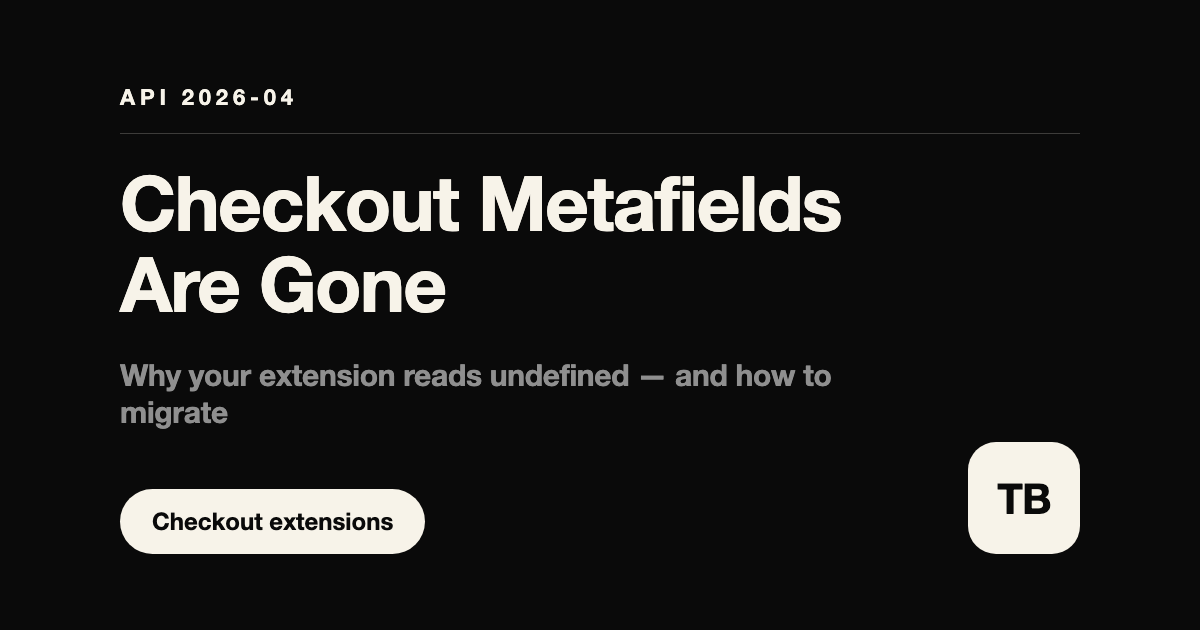
A checkout UI extension that worked for months upgrades to API version 2026-04, and suddenly every metafield read comes back undefined. No deprecation error, no crash, no failed deploy. The extension renders, the data is just gone. That silence is why this change is catching so many teams: it looks like a bug in your code, and it is actually a platform migration you have not done yet.
As of 2026-04, checkout metafields no longer exist as a readable or writable surface inside checkout and customer account UI extensions. Shopify replaced them with cart metafields in checkout UI extensions and order metafields in customer account UI extensions. The rename is not cosmetic. It is a different data source, with a different access pattern and different timing semantics, and extensions written against the old model need to be migrated deliberately.
What actually changed
- ✓Checkout UI extensions now read cart metafields — data attached to the cart object, set before or during checkout
- ✓Customer account UI extensions, including order status surfaces, now read order metafields — data that exists after the order is created
- ✓Anything that wrote checkout metafields as a side channel during checkout needs a new home for that data
- ✓Separately, invalid metafield queries in the GraphQL Admin API now return errors instead of failing silently — sloppy queries that used to pass are now loud
Why undefined, and not an error
The old checkout metafield references simply resolve to nothing under the new API version. From the extension's point of view, the field was never there. That is the worst failure mode for debugging, because everything downstream of the read — conditional rendering, delivery instructions, gift messaging, B2B fields, loyalty logic — degrades quietly instead of breaking visibly. Merchants notice missing checkout behaviour days before anyone finds the cause.
"Silent undefined is worse than a hard error. The extension keeps rendering while the logic behind it quietly stops existing."
— Thought Bulb
How to migrate without guessing
- ✓Inventory every extension target you ship and list each metafield it reads or writes, and at what moment in the buyer journey
- ✓Ask one question per field: does this data belong to the cart before purchase, or to the order after purchase? That answer decides cart metafield versus order metafield
- ✓Move checkout-time reads to cart metafields and make sure whatever sets them does so before the buyer reaches that step
- ✓Move order status and post-purchase reads to order metafields
- ✓Update your input queries and definitions to match, then test the full journey on a development store pinned to 2026-04 — not just the extension in isolation
Pinning an old API version buys time, not a fix
Extensions pinned to pre-2026-04 versions keep working for now, which is exactly what makes this dangerous. API versions sunset on a schedule, and the migration cost is identical whether you pay it this quarter under control or during Q4 under pressure. If your checkout has customisations you did not build in-house, it is worth confirming today which API version your installed apps' extensions target, because their migration timeline silently becomes yours.
Shopify's changelog entry documents the deprecation and the replacement surfaces.
Read the official deprecation notice →Thought Bulb migrates checkout extensions, audits which of your installed apps are exposed, and retests the full checkout journey — scoped as a fixed task, not an open-ended retainer.
Get your checkout extensions migrated →