A fractional Shopify developer usually costs between $1,000 and $5,000 a month, depending on hours and seniority. Below roughly 75 hours of real work a month, it tends to cost less than a US hire, and you skip recruiting. Above that, start thinking about a salary.
I run a studio that sells this, so weigh my view accordingly. The prices below are other people's published numbers, with links, so you can check them.
What fractional means on a Shopify store
You buy a share of a developer's month. They sit in your Slack, take tickets from your board and learn how your theme, apps and data fit together. The difference from a freelancer is continuity. The same person comes back next month and already knows why the cart drawer was built that way.
It is close to a retainer, and many agencies use the words interchangeably. What you should check is who does the work and whether you can talk to them.
What Shopify retainers cost in 2026
- ✓DigitalSuits lists $900 for 15 hours, $1,400 for 25 and $2,000 for 40, so about $50 to $60 an hour.
- ✓Storetasker puts boutique agencies at $90 to $125 an hour and gives $3,000 for a 30-hour retainer as an example.
- ✓Netalico lists $5,100 for 30 hours, $7,500 for 45 and $10,000 for 60, which is about $167 to $170 an hour.
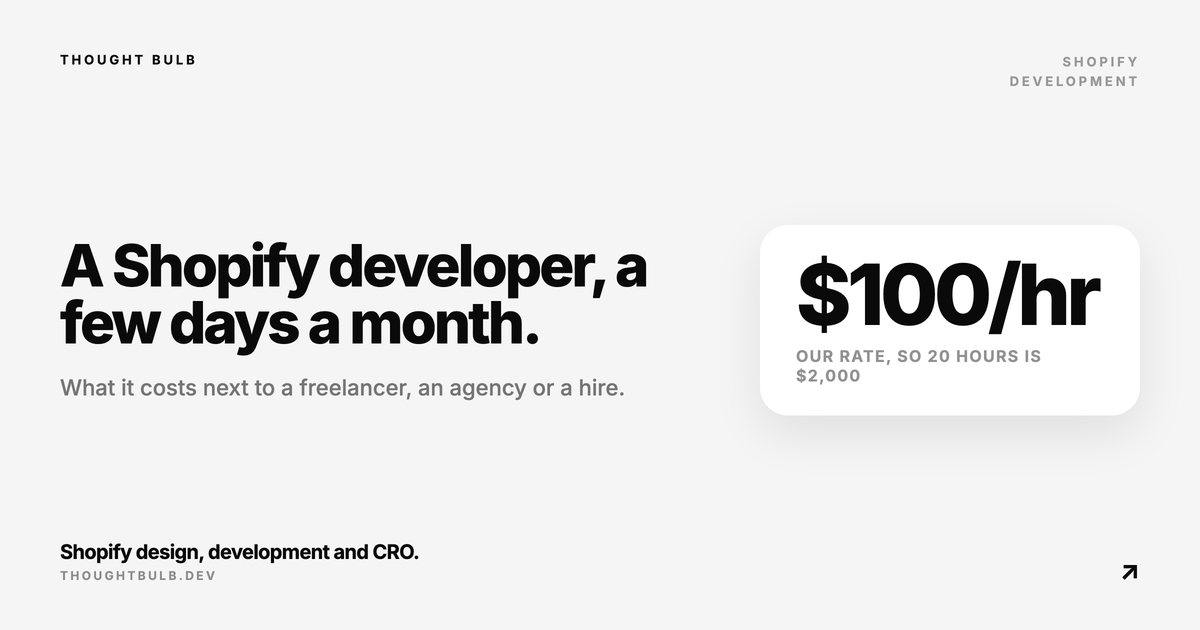
- ✓Thought Bulb charges $100 an hour, so 20 hours is $2,000.
These prices were on the linked pages in November 2026 and may change. Lots of agencies publish no retainer price at all, so expect to ask.
Fractional, freelancer, agency or hire
Here is how I would pick:
- ✓Freelancer: a defined job, a tight budget, and you can check the work yourself.
- ✓Fractional developer: a steady backlog that never quite justifies a proposal, and no developer on your team.
- ✓Agency retainer: several disciplines at once, such as design, CRO and development, with someone managing them.
- ✓Full-time hire: enough work to fill most of the month, plus someone who can manage a developer.
Marketplaces sit alongside these. Toptal offers a shortlist and a trial period, and Storetasker introduces you to vetted experts who set their own quotes. Both can work well, and you will still need to run the relationship yourself.
The break-even against a full-time hire
The US Bureau of Labor Statistics put the median web developer wage at $90,930 in May 2024. That is about $7,600 a month before benefits, payroll taxes, equipment and recruiting. A senior Shopify specialist in a big city will likely cost more.
At $100 an hour, $7,600 buys about 75 hours. So if your real backlog is 20 hours a month, a hire costs several times what the work needs. If it's 120 hours, fractional is the expensive option and you should hire.
A hire also needs managing. A developer with nobody setting priorities will find their own, and they might not be yours.
How to work out your hours
- ✓Write down everything you wanted changed in the last three months, shipped or not.
- ✓Ask a developer to estimate each item in hours. Your guess will be off.
- ✓Add about a quarter for meetings, testing and things that turn out harder than they looked.
- ✓Divide by three.
Start lower than the result. You can raise the hours once you see how fast the list moves, and a small first month tells you whether the developer is any good.
What to get in writing
Terms are where retainers go wrong, and they're often the vaguest part of the page. Before you sign, ask about:
- ✓What happens to unused hours, and for how long they carry over
- ✓The rate for extra hours in a busy month
- ✓Typical response time, and what counts as urgent
- ✓Who sets priorities on your side
- ✓Who owns the code and who holds the repository
- ✓The notice period, and whether you can pause
If you are weighing a retainer against sprints or a fixed project, retainer or sprint covers how to choose based on how often your backlog changes. Our notes on hiring a Shopify agency help if you're still comparing partners.
We work as a fractional Shopify developer for brands that don't have a full-time developer's worth of work, at $100 an hour.
See how it works →