A Shopify redesign should not depend on a room full of people agreeing that the new version looks better. The commercial question is whether the new experience helps more qualified visitors find products, understand the offer, and complete a purchase without creating new friction elsewhere.
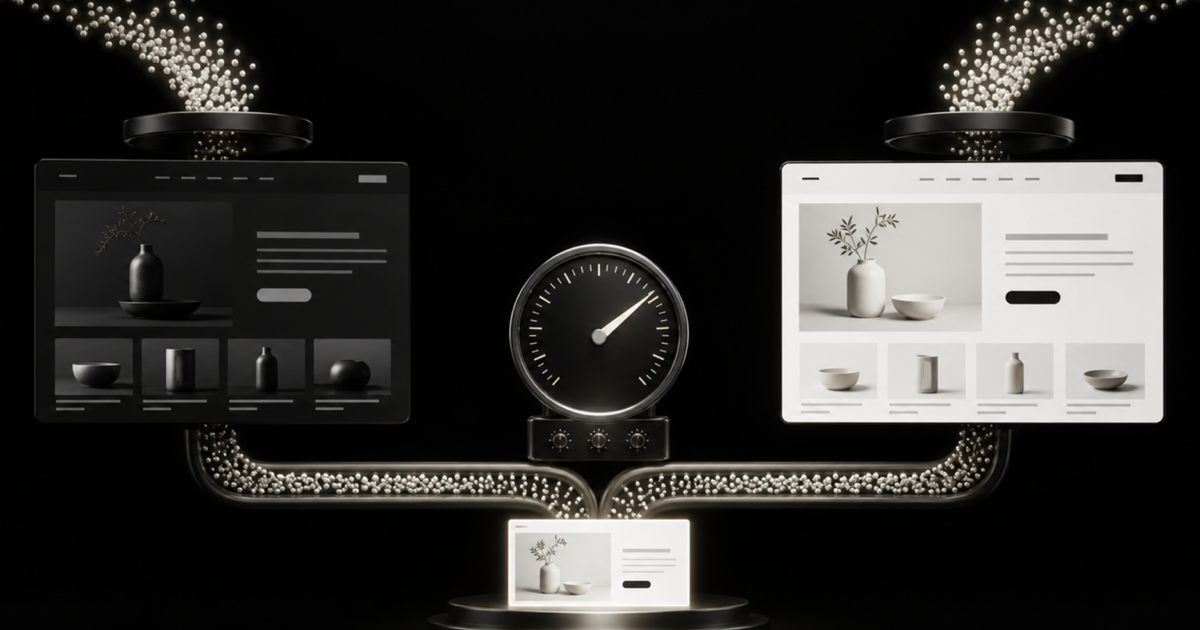
Shopify Rollouts makes that decision more measurable. Merchants can compare a changed theme against the current theme using live traffic, review conversion impact, and choose the winning version. The important work still happens before the test: deciding what to change, what success means, and whether the test can answer the question cleanly.
The short answer
Use Shopify A/B testing to validate a meaningful redesign hypothesis, not to outsource design judgment to a dashboard. Build one coherent variant, protect tracking and operational flows, choose a primary metric before launch, and give the result enough traffic and time to be credible. Rollouts handles traffic allocation; a sound CRO programme determines whether the result is useful.
What Shopify Rollouts changes
Shopify announced Rollouts in March 2026 with scheduling, automatic reversion for time-limited campaigns, and theme A/B testing. Rollouts can also target a specific market on eligible plans. That removes some infrastructure work, but it does not decide whether the experiment is well designed or whether analytics can explain the outcome.
- ✓Compare a redesign candidate against the current production theme
- ✓Schedule a release or campaign and define when it should end
- ✓Target market-specific storefront changes on eligible Shopify plans
- ✓Review conversion impact before selecting the version to keep
- ✓Revert a promotional experience without relying on a manual midnight deployment
Do not test an entire redesign as one unexplained bundle
A full redesign may change navigation, collection discovery, product cards, PDP hierarchy, typography, merchandising, cart behaviour, performance, and mobile interaction at once. If the new theme wins, you will not know which changes created the gain. If it loses, you will not know which part deserves revision. Group changes around a clear strategic hypothesis, then preserve that logic throughout the variant.
"The strongest redesign test is not old versus new. It is a specific customer problem versus a deliberate solution."
— Thought Bulb
A practical redesign experiment sequence
- ✓Define the buyer problem using behavioural data, support patterns, and commercial priorities
- ✓Choose one primary outcome such as purchase conversion, product discovery, or progression to checkout
- ✓Build a coherent theme variant around that outcome without unrelated visual churn
- ✓QA analytics, consent, markets, discounts, subscriptions, search, cart, checkout, and app integrations
- ✓Launch with an agreed traffic split and guardrail metrics such as revenue per visitor, returns, or support contacts
- ✓Run through normal weekday and weekend patterns, then interpret the result in commercial context
- ✓Ship the winner deliberately and use the evidence to choose the next experiment
When A/B testing is the wrong tool
Do not use an experiment to postpone an obvious repair. Broken mobile layouts, inaccessible controls, incorrect analytics, missing product information, and slow interactions need direct fixes. A/B testing is most valuable when both versions are viable and the business genuinely needs evidence to choose between them.
Shopify's Rollouts announcement explains theme A/B testing, scheduled storefront changes, automatic reversion, and market targeting.
Read the Shopify Rollouts update →Thought Bulb can turn your redesign priorities into buildable variants, preserve the Shopify integrations that matter, and implement a measurement plan that produces a decision rather than more dashboard noise.
Plan an A/B testing programme →