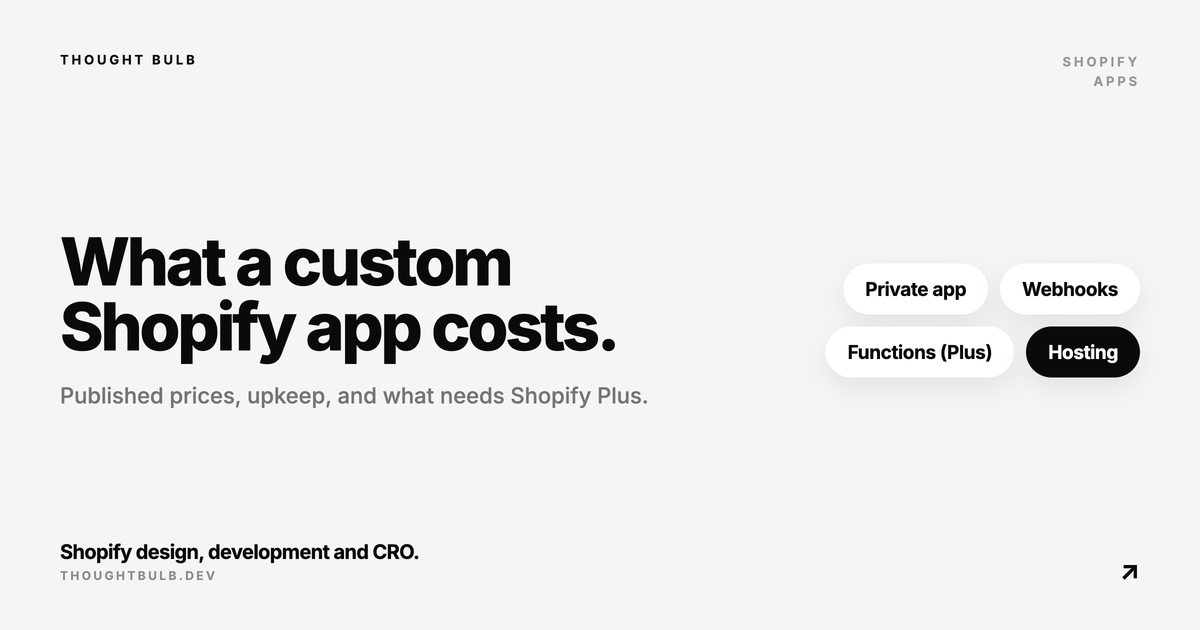
A simple custom Shopify app usually costs between $5,000 and $20,000, and a complex one can pass $50,000. Ours start at $3,500 for a single-purpose job. Before you pay for any of that, make sure no App Store app already does at least most of the work.
What agencies publish
- ✓CartCoders lists $5,000 to $15,000 for a simple private app and $40,000 to $200,000 and up for a complex public app.
- ✓Identixweb says around $5,000 to $10,000 for basic, $10,000 to $25,000 for mid-level and $40,000 to $80,000 and up for advanced.
- ✓Blackbelt Commerce gives $8,000 to $20,000 for a simple app or integration, $20,000 to $50,000 for mid-complexity and $50,000 to $80,000 and up for enterprise.
- ✓Thought Bulb starts at $3,500, with a fixed quote after a written spec.
These were on the linked pages in November 2026. Watch for quotes that mix private and public apps. A private app serves one store and skips App Store review. A public app has to pass that review, handle billing and serve stores you've never seen, so it costs much more.
What pushes a quote up
- ✓Writing data: an app that changes orders or inventory needs far more testing than one that reads them.
- ✓Outside systems: an ERP, 3PL or freight API brings its own rules, outages and documentation gaps.
- ✓Checkout: anything customers touch while paying has to be right every time.
- ✓Admin screens: a simple settings page is cheap, and a tool your team uses all day is a product.
- ✓Edge cases: partial refunds, split shipments and cancelled orders are where the hours go.
A carrier service app is a useful example. Our Blue Ridge build has to pack the cart, ask EasyPost for parcel rates and Echo for LTL freight, and return real prices inside a live checkout. Each of those steps can fail on its own, and all of them have to be tested.
What it costs after launch
Hosting is the small part. We run our apps on Fly.io, which lists a shared-CPU machine at $3.69 a month for 512 MB and $6.70 for 1 GB, with storage volumes extra. The larger cost is keeping the app current, because Shopify releases new API versions and retires old ones on a schedule.
Custom apps also can't use Shopify's app billing, so you'll pay your developer directly. Agree who holds the hosting account and the code before the build starts.
Check your plan before you scope anything
Plan limits can change what's possible. Custom apps that contain Shopify Functions run on Plus stores only, while public App Store apps with Functions work on all plans. Checkout UI extensions on the information, shipping and payment steps need Plus as well. Webhooks, the Admin API and theme app extensions work on every plan.
So a discount rule that a public app handles on your plan might not be buildable as a custom app unless you're on Plus. I'd check that in the first call, because it can rule out the whole idea.
When an App Store app is the better buy
If an app covers most of the job and the gap is cosmetic, install it. Reviews, subscriptions, search and loyalty are solved problems. When an app should be custom-built goes through the signs in more detail, and the app stack audit helps you see what your current apps cost you.
Build when the gap is the job itself: a price only you can calculate, an integration nobody sells, or three apps and a spreadsheet doing what one small service could.
We build private Shopify apps from $3,500, and we run four of our own on the App Store.
Custom app development →