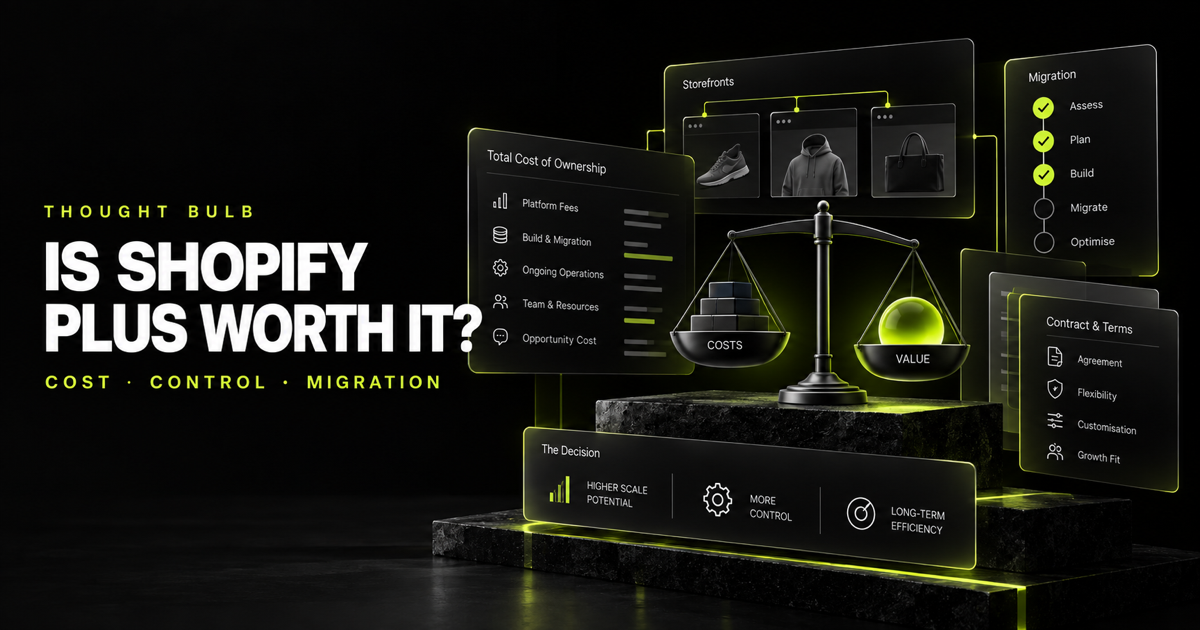
A September Reddit post from a merchant who regretted moving a long-established business to Shopify Plus drew more than 160 upvotes in two weeks. The complaints were not about button colours. They were about control: the Shop app, support, ecosystem dependence, and how hard the platform would be to leave after the business had rebuilt itself around it.
One angry thread is not a representative customer survey. It is still useful research. It names the questions that polished migration decks tend to skip, and those questions deserve answers before an established store signs a multi-year platform agreement.
Start with the price Shopify publishes, then build the price you will actually pay
As of September 2026, Shopify publishes a starting price of $2,300 USD per month on a three-year term or $2,500 on a one-year term for a standard Plus setup. More complex or higher-volume businesses can move to a variable platform fee. That gives finance a clean licensing line, but it is not the total cost of ownership.
- ✓Platform fee and payment-processing costs under the exact contract and countries you will use
- ✓Migration discovery, data mapping, build, QA, redirects, training, cutover, and post-launch support
- ✓Apps charged per store, including separate fees across expansion stores where applicable
- ✓Theme licenses, custom development, integrations, monitoring, accessibility, and recurring maintenance
- ✓The period when the old and new platforms run at the same time
- ✓The internal time spent by ecommerce, operations, finance, support, legal, and merchandising teams
"The question is not whether $2,300 a month sounds expensive. It is whether Plus removes more cost and constraint than it introduces across the whole commerce operation."
— Thought Bulb
Upgrade for a capability you can name, not a revenue milestone
There is no universal revenue line where Plus suddenly becomes sensible. A $20 million brand with a simple domestic catalog may need fewer Plus-only capabilities than a smaller company running B2B, multiple markets, complex permissions, flash drops, and deep integrations. Build the case from operational requirements, not prestige.
- ✓B2B: company accounts, price lists, payment terms, deposits, quantity rules, and B2B-specific storefront behavior
- ✓Organization control: centralized users, billing, security, and custom organization roles across stores
- ✓Expansion stores: one main store and up to nine eligible expansion stores under the standard contract, while remembering that their data and settings remain independent
- ✓Checkout and backend logic: extensions and Shopify Functions that replace brittle scripts or app workarounds
- ✓Scale: higher API capacity, high-volume checkout requirements, and launch-specific bot protection
- ✓Economics: payment or transaction savings that can be calculated against present order volume
Treat channel control as a contract question, not an onboarding surprise
The current Shop rules are a useful example. Shopify says eligible merchants are automatically searchable in the Shop app and on the Shop website, even without installing the Shop sales channel. Merchants can control direct selling and hide individual products, but Shopify's help center says an eligible merchant cannot stop the entire store from being discoverable in Shop.
Some brands see that distribution as useful. Others see a platform-owned shopping surface as a strategic compromise. Neither reaction is irrational. The mistake is discovering the rule after migration. List every surface that can represent, distribute, price, recommend, or transact your products, then decide which controls are mandatory before the contract is signed.
Portability is a map of dependencies, not a CSV checkbox
Shopify supports exports for products, customers, orders, discounts, gift cards, financial records, and themes. Those exports matter. They do not recreate the operating system that grows around a mature store. The difficult parts of an exit usually sit in app databases, subscription records, loyalty balances, automation, search rules, metafields, metaobjects, feeds, pixels, consent state, ERP mappings, and customer-account behavior.
- ✓For every app, document what data it owns, how it exports, and what becomes unreadable when the subscription ends
- ✓Keep integration mappings and transformation rules in company-controlled documentation and repositories
- ✓Store theme code in version control rather than treating the published theme as the only source of truth
- ✓Separate portable business rules from platform-specific implementation where the economics justify it
- ✓Run a sample export before migration approval, not only when the business wants to leave
Run the ugly workflows in a test store
A migration demo usually follows the happy path: find a product, add it to cart, pay, celebrate. Established businesses break at the edges. Test split shipments, partial returns, edited orders, tax exemptions, subscription changes, gift cards, loyalty redemption, preorder stock, wholesale terms, fraud review, address changes, failed payments, ERP outages, and customer-service corrections.
If a workflow accounts for little revenue but creates a disproportionate amount of support or finance work, it still belongs in discovery. A platform decision is an operating-model decision wearing a software badge.
Score Plus against three honest alternatives
- ✓Stay on the current platform and fix the specific constraints that triggered the replatforming conversation
- ✓Move to a non-Plus Shopify plan and add only the capabilities the business actually needs
- ✓Move to Shopify Plus with a documented capability, cost, migration, and exit case
- ✓Choose another enterprise platform because ownership, data model, B2B, regional, or integration requirements outweigh Shopify's operational advantages
Use the same scorecard for all four: three-year cost, implementation risk, time to change, checkout and merchandising capability, international and B2B fit, data portability, support model, internal staffing, and the cost of reversing the decision. If Plus wins only when the presentation uses different assumptions for each option, it has not won.
The answer can be yes without pretending the tradeoffs disappear
Shopify Plus can remove a great deal of infrastructure and upgrade work, give teams a capable commerce foundation, and make complex storefront delivery faster. It can also create ecosystem dependence and constraints a business should price deliberately. Good due diligence is not anti-Shopify. It is how a serious business becomes a good Shopify customer instead of a surprised one.
Need an independent technical scope before a Shopify or Shopify Plus build? We can map the storefront, integrations, migration risks, and work the platform choice creates.
Scope the Shopify work →Sources and discussion trail
Shopify's current Plus pricing page lists the published starting fees, term options, transaction notes, expansion-store allowance, and feature set used in this analysis.
Read Shopify Plus pricing →Shopify's help center explains automatic Shop discoverability and the controls merchants have over individual product visibility.
Review Shop eligibility rules →Shopify's backup and duplication guide lists the records merchants can export and the store data that still requires manual or app-specific handling.
Review Shopify data portability →This highly discussed merchant thread is an anecdotal input, not a representative benchmark. It is included so readers can inspect the complaints and responses directly.
Read the merchant discussion →